
Here are the 5 most important questions you should ask yourself about your academics and career, with direct answers.
1. Do my grades actually support the career I say I want?
Do not answer this emotionally. Answer it from your transcript.
If you want a software role, your grades in programming, data structures, databases, algorithms, cloud, AI, and related labs should be strong. If you want a core electronics role, your grades in circuits, devices, communication, embedded systems, VLSI, and labs should be strong. If you want analytics, your grades in mathematics, statistics, programming, and data-oriented courses should be strong.
If your grades are weak in the very subjects your target career depends on, then your current academic record does not support that career strongly yet. That does not mean you must give up. It means you need to fix the gap through better grades in upcoming courses, stronger projects, internships, certifications, and serious preparation. But first, you must stop pretending that interest alone is enough. Recruiters look for evidence, not intention.
2. If a recruiter sees my transcript today, what will they think I am good at?
This is one of the most useful questions you can ask.
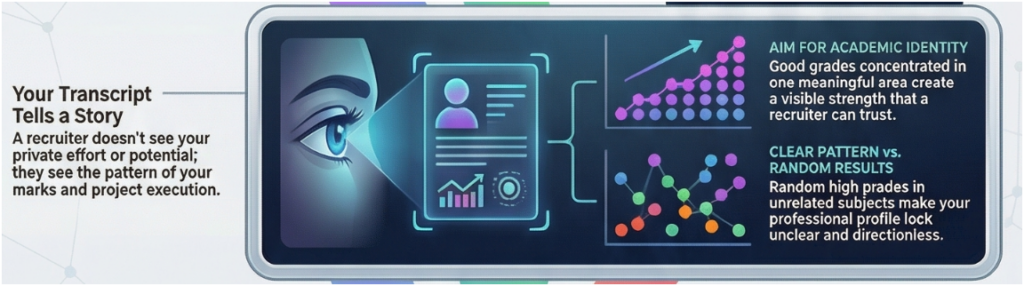
A recruiter does not know your struggle, your potential, or your private effort. They see your marks, your course grades, your projects, and your resume. So ask yourself: what does your transcript clearly show?
Does it show:
- strong programming ability?
- strong core electronics knowledge?
- strong analytical ability?
- strong project execution?
- strong communication and presentation skills?
Or does it show no clear pattern at all?
Your transcript should tell a story. If your good grades are concentrated in one meaningful area, that becomes your academic identity. If your grades are random, your profile looks unclear. So do not just look at whether you passed. Look at whether your grades are building a visible strength that a recruiter can trust.
3. Am I studying to pass, or studying to build a career profile?
There is a big difference.
If you study only to pass, you will clear semesters and move forward. But your transcript may remain weak, average, or directionless. If you study to build a career profile, you will start treating each course as part of your future.
That means:
- taking core courses seriously
- scoring high in subjects related to your target role
- choosing electives intelligently
- connecting grades with projects and internships
- using each semester to strengthen one clear direction
Your career profile is built long before final year. Every course adds to it. Every grade either strengthens your profile or weakens it. So stop thinking, “I just need to clear this subject.” Start asking, “How does this subject help me become ready for the role I want?”
4. What are my real strengths and real weaknesses based on my grades?
Do not guess. Use your marks honestly.
Group your courses into skill areas:
- mathematics and analytical foundation
- programming and computing
- core domain knowledge
- laboratory and hands-on skill
- design and innovation
- project and problem solving
- communication and professional skills
Now look at your grades inside each group. The areas where you repeatedly score high are your real strengths. The areas where you keep getting average or low grades are your weaknesses or developing areas.
This matters because you should build your career on your strengths, not on fantasy. At the same time, you should not ignore weaknesses if they are important for your desired field. If a key skill area is weak, either improve it seriously or be realistic about changing direction. Self-awareness is better than late disappointment.
5. What should I do if the career I want does not match my current academic performance?
First, be honest. Then act.
If your target career and your grades do not match, you have only two sensible options:
- improve that area quickly and seriously, or
- rethink your target based on where you are actually strong
If you truly want that career, then do not just hope. Build evidence:
- improve grades in the next relevant courses
- choose supporting electives
- do one strong project in that area
- take an internship or certification
- prepare technically for interviews
If you do this well, your later semesters can strengthen your profile enough to change how recruiters see you.
But if you repeatedly struggle in that domain even after effort, do not force yourself into it only because it is popular. Choose a nearby path where your strengths have better value. That is not weakness. That is smart career planning.
Final message to you
Your grades are not just marks. They are signals.
They tell:
- what you understand well
- where you are consistent
- what roles you may be ready for
- where you still need work
So read your transcript properly. Use it to plan your electives, projects, internships, and placements. Do not wait until final year to discover what your academic record is saying about you.
Your CGPA gives a summary.
Your course grades reveal your true career direction.
Author
Dr R K Suresh
Former Chairman, BTech (Admissions)
Amrita Vishwa Vidyapeetham (All Campuses)